 EMERGENCY


Power failure events can happen anytime. A hospital cannot afford a shutdown when patients depend on life-saving equipment. Similarly, a data center cannot risk downtime when important applications and valuable information sit on its servers. That is why NFPA 110 generator requirements establish clear expectations for the emergency power systems.
What Is NFPA 110?
NFPA 110 sets the requirements for emergency and standby power systems that take over when normal electricity fails. Hospitals, data centers, and other important facilities rely on this standard to ensure backup power remains available when it is needed most. The standard uses three classifications to define how an emergency power system should perform.
Industrial generators designed for healthcare facilities, data centers, and other mission-critical environments are often configured to meet NFPA 110 standards and emergency power performance requirements.
NFPA 110 Type
Type refers to the amount of time a system has to restore power after an outage. This includes:
1. An NFPA 110 Type 10 system, which is common in hospitals and other critical facilities, must restore power within 10 seconds of an outage.
2. An NFPA 110 Type U system delivers power with little or no interruption, which makes it suitable for applications where even a brief loss of power is not acceptable.
3. An NFPA 110 Type M system works differently because it relies on manual operation and does not have a specified time limit for restoring power.
The required Type depends on the level of protection and continuity that a facility needs during a power failure.
NFPA 110 Class
Class refers to how long the system can continue operating without refueling or recharging. Some applications require only a short period of backup power, while others need many hours of continuous operation. The required runtime depends on the facility and the risks associated with a power outage. Some of the most commonly specified classes include:
1. The Class 6 system must provide backup power for at least 6 hours without refueling.
2. The Class 48 must support continuous operation for 48 hours.
3. The Class 72 system must remain operational for 72 hours.
4. The Class 96 system must provide at least 96 hours of runtime, a common requirement for hospitals and other critical facilities.
5. For the Class X system, the runtime is determined by the facility, application, or governing code rather than a predefined duration.
NFPA 110 Level
Level identifies the importance of the loads connected to the system. Level 1 applies where a power failure could put lives at risk or cause very serious harm. Level 2 applies to less important applications. Although the impact of failure differs, both levels require regular generator maintenance under NFPA 110 testing standards.
Most hospitals operate under a Level 1, Type 10, Class 96 configuration because patient safety depends on immediate power restoration and extended generator runtime. Similarly, data centers generally use Level 1, Type 10 systems. However, runtime requirements often vary based on business continuity goals and fuel supply system capacity.
What Is an Emergency Power Supply System (EPSS)?
NFPA 110 separates emergency power infrastructure into two important categories.
1. An emergency power supply system (EPSS) serves as the actual source of backup electricity. The supply includes the generator, engine, batteries, starting system, and fuel source.
2. An EPSS includes the power source and all components required to supply electricity to essential loads. The system includes conductors, protective devices, controls, monitoring equipment, battery systems, and transfer switches.
This distinction matters because NFPA 110 compliance for generators applies to the complete system rather than a single piece of equipment. For example, a generator with excellent performance cannot compensate for a failed transfer switch or defective control panel.

Hospital and Data Center Requirements Compared
Standby generator code requirements for healthcare facilities and data centers share several similarities.
|
Requirements |
Hospitals |
Data Centers |
|
NFPA 110 Classification |
Level 1 |
Level 1 |
|
Transfer Requirement |
Type 10 |
Typically Type 10 |
|
Runtime Requirement |
Class 96 |
Usually Class 24 to Class 72 or higher |
|
Monthly Testing |
Required |
Required |
|
Annual Load Testing |
Required |
Required |
|
Redundancy Strategy |
Essential Electrical System (EES) |
N+1 or 2N Architecture |

NFPA 110 Generator Requirements for Hospitals
Hospitals operate under some of the strictest backup power regulations in any industry. Patient safety depends on immediate access to electricity. Medical staff cannot wait several minutes for power to be restored during an emergency. NFPA 110 works alongside NFPA 99 to establish healthcare-specific requirements for hospital backup generators. This includes:
1. A hospital emergency power system must achieve Type 10 performance. The system must restore power within ten seconds of utility failure.
2. Hospitals must also maintain enough fuel for at least 96 hours of continuous operation.
Hospital power distribution follows three separate branches.
1. Life Safety Branch: This supports emergency lighting, fire alarms, communication systems, and exit pathways.
2. Critical Branch: This branch supports operating theatres, intensive care units, patient care equipment, and nurse stations.
3. Equipment Branch: This branch supports HVAC equipment, medical air systems, vacuum systems, and supporting infrastructure.
NFPA 110 Generator Requirements for Data Centers
Data centers face various risks, yet the importance of reliable backup power remains equally high. A longer outage can disrupt customer services, interrupt business operations, damage equipment, and create significant financial losses. Many operators design facilities with multiple layers of redundancy. This includes:
1. An N+1 design provides one additional backup component beyond the minimum requirement.
2. A 2N design provides complete duplication of important infrastructure.
Generator systems are often installed within dedicated fire-rated enclosures. These systems are supported by fuel storage, ventilation, cooling, and monitoring systems designed for continuous operation.
What Are the Fuel Storage Requirements for NFPA 110 Compliant Generators?
Fuel storage represents one of the most important aspects of emergency power planning. NFPA 110 requires fuel supplies capable of supporting the assigned system class. The standard also requires additional capacity equal to 133% of the fuel needed for the specified runtime.
1. Diesel remains the preferred choice for many hospitals and data centers. Diesel fuel offers long-term storage capability and reliable energy density.
2. Natural gas systems are also used in many applications where utility infrastructure provides a dependable fuel source.
Facility managers should evaluate fuel availability, storage regulations, and emergency delivery arrangements before selecting a fuel strategy.
Automatic Transfer Switch Compliance
A generator cannot restore power unless electrical loads transfer correctly. This responsibility belongs to the automatic transfer switch (ATS). The transfer switch continuously monitors incoming utility power. The switch detects an outage and initiates generator startup when voltage drops below acceptable levels. This is why proper compliance with automatic transfer switch requirements plays a major role in overall system reliability.
Generator Installation and Environmental Requirements
NFPA 110 installation guidelines for generators are important for their performance and reliability. NFPA 110 Chapter 7 covers major factors such as location, mounting, noise control, lighting, vibration, HVAC, cooling, fuel supply, exhaust systems, protection, and power distribution. The chapter also requires acceptance testing to verify that the system will perform as expected before an actual power outage occurs.
Emergency Generator Testing Requirements
Emergency generator testing requirements under NFPA 110 are designed to confirm system readiness.
Monthly Operational Testing
Monthly testing requires operation under load for at least 30 minutes. Plus, the generator should reach an adequate operating temperature and maintain acceptable load levels during the test.
Annual Load Bank Testing
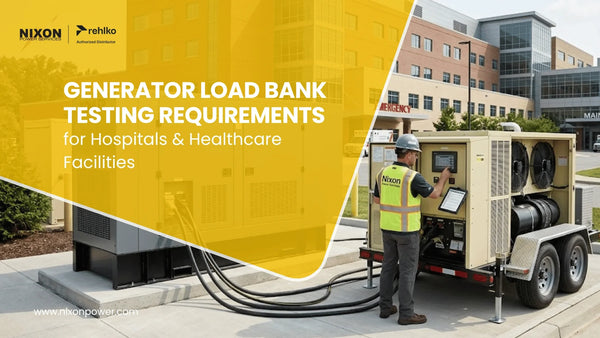
Annual load bank testing verifies generator performance under higher loads. This test confirms that the generator can deliver its rated output when required.
Triennial Testing
Level 1 systems require complete testing every 36 months. This evaluation confirms that the complete EPSS can support essential loads during an extended outage.
Is Your Monthly, Annual or 36-Month Test Coming Up?
Nixon’s factory-trained technicians run NFPA 110 load bank testing and prepare the test records your inspector will ask for.
Final Thoughts on NFPA 110 Generator Requirements
NFPA 110 provides a clear framework for designing, operating, and maintaining emergency power systems in hospitals and data centers. From generator sizing and fuel storage to testing and transfer requirements, every aspect contributes to system reliability.
At Nixon Power Services, we help organizations design, install, maintain, and service reliable backup power systems. As a leading distributor of Kohler industrial generators, we provide dependable power solutions for healthcare facilities, data centers, and other facilities.